


| << Prev || עברית || Français || Русский || Next >> |
Part Three - The Social Program
The War on Traffic Accidents
Returning the Element of Responsibility to Israeli Drivers
Zehut will tackle the root problem of traffic accidents, based on the Jewish principle of the "unintentional killer," whereby a person is responsible for the consequences of his actions and not only for his intentions. The goal is to maintain adequate insurance coverage for all MVA victims, and yet to restore full responsibility to drivers and create a different driving culture in Israel.
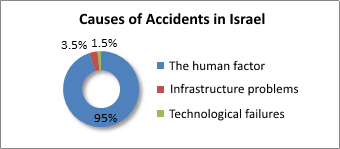
We believe that the adoption of this principle and restoration of the element of personal responsibility to Israel's roads will save a significant percentage of the hundreds of casualties and thousands of injuries each year as a result of MVAs.
In 2005, the Scheinin Commission submitted a report to the Transport Minister. The report stated that European studies indicate that more than 80% of accidents are caused by "the human factor"[27] - drivers who do not meet requirements such as driving alertness, understanding road conditions, and compliance with traffic laws. In a 2015 study by the U.S. Department of Transportation, it was determined that 94% of accidents are caused by drivers.[28]
In 2005, a study was published by the Matat Institute for the Transport Ministry. The results showed that in 2000-2002, the average cost of damage caused by road accidents amounted to 12.6 billion shekels annually, or about 2.5% of GDP. If we calculate this data in relation to the number of residents in Israel, the cost amounts to 1,880 shekels per year per resident, This is roughly the amount that every driver pays for his compulsory insurance.
In the present method, the driver does not feel that the responsibility falls on him to prevent traffic accidents. The system, read: the state, the police and the courts – these are responsible for what is happening on the roads. They set the rules, they warn, they educate, and they punish. In contrast, the "job" of the driver is to act according to law and/or try not to be caught by a policeman. He does not feel any responsibility because he does not deal directly with the consequences of his actions. Someone can run into a pedestrian and not have any contact, either on an economic or emotional level, with the victim. Compulsory insurance automatically pays the victim, while the legal system might punish the offender for negligence.
The Israeli driver sees "penalties" around him – not people. In such a reality it is not possible to reduce the number of road accidents.
Compulsory Insurance Reform
The war on traffic accidents should begin to reestablish the relationship of direct financial responsibility between a person and his actions. The first step in building this relationship is a revolutionary reform in the structure of the compulsory insurance policy. When a person who causes an accident becomes liable for damages – increased road safety will result. In order to begin to restore the element of responsibility to Israeli drivers, we have defined, in consultation with experts in the Transport Ministry, seven offenses arising from conscious aggression on the roads. A driver caught violating any of these offenses[29] will be punished in accordance with the penalties set by law.
If a third party was also harmed as a result of the offense, the insurance company will compensate the victim as is done today, but afterwards, the insurance company may sue the offending driver for the full amount paid to the victim.
When the first accounts are published of drivers who injured people because of aggressive driving and were forced to spend the rest of their lives paying the full cost of the damage they caused, driving culture in Israel can be expected to change quickly. Many lives will be saved – as well as the vast sums that now burden the state budget.
Explanatory Notes to Bill P/1236/19 –5773–2013, filed by MK Moshe Feiglin:
The purpose of the proposed amendment is to restore the element of responsibility to motorists on the roads of Israel. By all estimates, the main cause of traffic accidents (more than 80% of cases) is the human factor, which also may be related to the "driving culture."
The proposed amendment seeks to deal with the deepest foundation that creates the negative driving culture in Israel – the fundamental of responsibility. In a survey conducted by the "Geocartography" institute for the magazine "Mahar," it became clear that to the degree that the population of young drivers has become more and more prone to reckless driving, so has insurance coverage become more important. This means that the fear of the financial consequences worries younger drivers more than responsibility to others. The goal of this amendment is to make it clear to drivers, especially young ones, that if they behave dangerously, they are likely to harm people - pedestrians and other drivers - and if they do so, they will be directly responsible for their actions.
Thus, the bill provides that in cases where a person sustains injury due to particularly dangerous driving, the offending driver will not receive insurance coverage and the insurance company will demand the expense from the offending driver after it compensates the victim.
The proposed amendment does not replace the punishment levied for perpetration of the offense, but rather places the financial responsibility for harm to the victim on the offender, in order to encourage responsible driving on the roads of the country.
After discussions with professionals, including the National Road Safety Authority, the proposed amendment is intended to add the following to the list of driving offenses for which an offending driver is rendered ineligible for insurance coverage: drunken driving when the concentration of alcohol in the driver's body exceeds twice the permissible limit; hit and run; driving at 50 kilometers per hour over the speed limit on intercity highways and 40 kilometers per hour over the speed limit on city streets; crossing a continuous dividing line; not stopping before a railway crossing; carrying cargo that exceeds the weight limit by more than 40%.
[27] "It is customary to assign factors of vehicle, road and environment as some of the causes of traffic accidents, while the human factor accounts for more than 80% of the reasons" –Scheinin Report, Section 2.1.
[28] https://crashstats.nhtsa.dot.gov/Api/Public/ViewPublication/812115
[29] Which include among other things – passing over a white line, entering the intersection when the red light has been on for more than one second, drunken driving and other clearly life-threatening offenses.
| << Prev || עברית || Français || Русский || Next >> |