


| << Prev || עברית || Français || Русский | |
Appendices
The Oslo Report: How much does the Oslo process really cost us? (4/4)
Components of the economic price (3/3)
The fall in tourism revenues in the peak years of terrorism
Tourism in Israel constitutes an important and significant component of the country's economy. This industry is constantly developing its ability to absorb tourists and provide them with services. Therefore, it is only natural that over time we will see a rising graph of the number of tourists arriving in Israel. The Oslo Accords were supposed to be a breakthrough that would allow the tourism industry to leap to new heights. In practice, the result was the opposite. The terror that took over the streets and the images of exploding buses drove many tourists from Israel, and for a long time even domestic tourism reached an unprecedented low.
In the graph below[103], we can see that since 1992, the number of tourist person-nights has increased, and that this trend was reversed in 1995. Towards the millennium, 2000, Israel was preparing to receive pilgrims on a huge scale. Roads were built, guest houses and hotels were built, and tourism eventually reached little more than the peak of 1995. As you can see, the events of 2000 brought tourism down to an unprecedented low, from which it managed to emerge only towards the end of the decade.
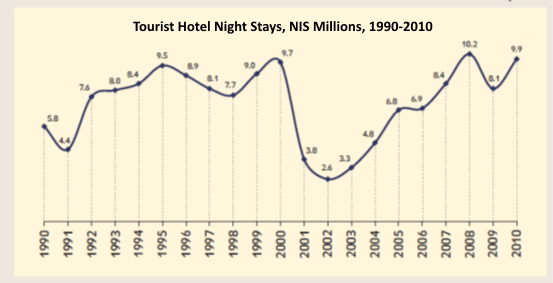
In 2010, the Ministry of Tourism reported that the contribution of tourism in this year to GDP was approximately NIS 33 billion[104]. In that year the number of tourists was 2.8 million[105], so the average contribution to GDP per tourist was about NIS 11,700 NIS. A calculation of the reasonable development of tourism in the years 1992 to 2013 against the reality of the large falls that are clearly visible in the graph shows that the loss to the Israeli economy was about NIS 130 billion.
It is important to remember that in addition to this, there is ongoing damage to tourism due to the continuing threat of terrorism and the ongoing damage to tourism development in Judea and Samaria, which has only recently recovered. Judea and Samaria are the cradle of Jewish and Christian culture. An unexploited "Israeli Tuscany", a small distance from Ben Gurion Airport, the sea, the Dead Sea and the holy places, with air and mountain views, and low humidity in the summer, and they therefore have a high potential for tourism development. It is difficult to estimate the exact loss. Since overall tourism is NIS 33 billion a year, this is at least a few billion a year, but in order not to get carried away, we will calculate the damage to tourism in Judea and Samaria as a "symbolic" one billion each year; i.e., NIS 20 billion since the Oslo Accords.
The total damage to tourism is estimated at NIS 150 billion.
The cost of evacuating the Jews from Gush Katif
In the first decade of the Oslo process, Israeli governments handed over more and more land to the "Palestinians," but none of them included a Jewish settlement. At the end of 2003, Prime Minister Ariel Sharon decided to unilaterally evacuate all Jewish settlements in Gush Katif in the Gaza Strip and four Jewish settlements in northern Samaria. The decision was made in the summer of 2005, and included the evacuation of all the thousands of residents in these communities. The cost of direct treatment of evacuees up to 2013 was NIS 9.5 billion, and 12% of them still live in temporary housing[106].
Additional factors
The Oslo process has had a significant impact on two main factors in the Israeli economy:
There is a close connection between the Oslo process and housing prices in Israel. The evacuation of the Jews from Gush Katif together with the construction freeze in Judea and Samaria are part of the reasons for the increase in demand for housing in the face of insufficient supply. It is no wonder that the housing protest erupted a year after the start of construction freeze in Judea and Samaria. The Oslo process does not allow for large-scale construction of the natural reserves of the entire coastal plain along the center of the country. Massive construction in these areas will significantly reduce housing prices, as proposed in the detailed position sheet that we published in the past[107]. The impact of the Oslo process on the cost of housing may be greater than any other item that we have listed here, but the calculation of this price will be essentially theoretical, so we will leave the reader, who is well aware of the cost of housing throughout the country, to place a value on it himself.
Terrorism caused damage to national productivity in several ways, such as the loss of many work days in times of emergency. Despite the surge in terror following the Oslo process, the Israeli economy continued to thrive. We do not have data on how much damage was caused to the economy in the loss of working days and the like, and it is impossible to estimate how much higher GDP would have been without the Oslo process. It is reasonable to assume that an economy that did not have to deal with these difficulties could have developed much better.
Road No. 1 from Tel Aviv to Jerusalem was planned and carried out before the Oslo Accords, so road planners had no problem determining that the route of the road would pass east of the Green Line. The planning of the rapid train to Jerusalem began after the Oslo Accords, and this had economic and environmental significance. The cheap and quick option for both construction and use was the construction of the railway along the route of Route 443. This option has the most suitable slopes for laying a railway. However, this possibility was rejected out of hand because it was east of the Green Line. The Israeli government has chosen to invest in the megalomaniacal alternative of 44-kilometers of the railway running through a tunnel and another 7 kilometers on bridges[108]. This damage, which is the result of the Oslo process, was not presented in the general summation. Its direct damage is approximately NIS 7 billion, and the indirect damage due to the long delay caused by the choice of this alternative is estimated at several tens of billions. Another example in the same context is Highway 6. A number of sections of this road were moved west from the original plan solely in order not to cross the Green Line. The state paid hundreds of millions for these corrections, even though the road was paved by a private company. One of the localities that suffers from this "correction" in a pronounced way is the settlement of Bat Hefer. This town is trapped between the separation fence wall to the east and the acoustic wall of Highway 6 from the west, where the road will pass east of it and allow it to develop westward.
Summary and conclusion
Twenty years after the beginning of the Oslo process, it is possible to establish as fact that its goals have not been achieved, because instead of ending the terror, it has actually grown strongly and steadily, and because after twenty years of negotiations, the end of the process, the end of the violence, and the end of the conflict have not been achieved, and cannot be seen on the horizon.
The total economic price, or at least its quantifiable components, is:
Transfer of funds to the Palestinian Authority: NIS 88 billion
The additional cost of the GSS: NIS 37 billion
The IDF's additional cost: NIS 300 billion
The Ministry of Internal Security and thefts of vehicles: NIS 105 billion
Adding civilian security guards everywhere in Israel: NIS 220 billion
Construction of the separation fence around the territories handed over to the "Palestinians": NIS 4.7 billion
The "value" of victims of hostile actions: NIS 12 billion
The decline in tourism revenues during the peak years of terrorism: NIS 150 billion
The cost of evacuating the Jews from Gush Katif is NIS 9.5 billion
Overall, the Oslo process has cost us NIS 926 billion so far.
If we divide this sum into 20 years of the "peace process" and compare it to the 2014 budget of NIS 406 billion, we get an annual cost of 11.4% of the budget in each of the past 20 years.
And there is no peace.
Looking back, this is probably the least worthwhile decision in Israel's history. In contrast to the Yom Kippur War, when after the mistake was made, it was too late to fix, the Oslo process continues, and we are still required to pay not only in money but also in the release of the murderers of our people and in the continued loss of moral legitimacy for our existence, despite the fact that we can and must end it.
The answer to the question "Where is the money?" Is that the money is in the price we pay for the delusion that if we just give in, we will receive "peace" or at least calm. The bitter truth is that we are in the process of violent and ongoing blackmail whose price is only rising.
[103] Central Bureau of Statistics 117 – Tourism and Hotels 1990-2010
[104] Ministry of Tourism website
[105] "Tourism to Israel 2010 – Statistical Report" Ministry of Tourism
[106] Arutz 7 ‐ 13 June 2013
[107] "The Shortage of Housing – A Position Paper", Manhigut Yehudit, Adar II 5771
[108] Arutz 7 ‐ 22 June 2008
| << Prev || עברית || Français || Русский | |