


| << Prev || עברית || Français || Русский || Next >> |
Part Five - The Economic Plan
Transportation (1/2)
Our sources have already granted the right of to develop transportation infrastructure to the state, even at the cost of local harm to private ownership: "The king ... and may break through to create a road, and we do not prevent him; the king's road has no measure"[4]. But unlike the basic construction of transportation infrastructure[5], it is possible to question the accepted view that the state's role is also to organize the use of that infrastructure. Is there any logical reason why the state should organize public transportation? Organization of public transportation by the state is an invention of modern states which has been accepted by many countries, but is there justification for it?
"There is a program that I would eliminate... the Amtrak subsidy (US passenger rail company)".
–Republican candidate Mitt Romney in the US presidential election in 2012
In 2016, the Transportation Ministry invested 5.2 billion shekels in subsidies for public transportation and another 3.8 billion shekels for the purchase of equipment and infrastructure for public transportation. The Transportation Ministry selects and purchases buses for all bus companies and train cars and engines for Israel Railways.
Tax revenues from cars were more than 40 billion shekels, while only 6.1 billion shekels were spent on paving roads. In other words, the lion's share of the money collected from car owners is not returning to them as infrastructure, but is diverted to public transportation and other purposes of the state budget.
The State of Israel invests a lot of money to educate the public to abandon their private cars and switch to public transportation[6], but it should be remembered that full buses are profitable and will travel even if the state does not fund them. Half-empty buses with engines five times to ten times that of a small car, which travel longer routes to their destination and and stop a lot, create a lot of air pollution, are not profitable, and continue to operate only in order "to educate the public to abandon the private car."
The high tax on vehicles increases the value of the vehicles and as a result, older vehicles, which in other countries would have been thrown into the junkyard, continues in Israel to move on the roads. In these vehicles, the oil systems aren't completely sealed any more and they therefore pollute the air more.
The Transportation Ministry is opposed to sharing private vehicles[7], thus increasing the number of private vehicles on the road, but spends a fortune developing public transportation.
Autonomous vehicles which already travel without a driver in several countries, will soon come to Israel and will constitute significant competition to public transport. In an autonomous vehicle, there is no need to drive and the vehicle takes the passenger to his destination in the fastest way.
Zehut is of the opinion that a free country does not educate its citizens. A free citizen may choose to travel in any vehicle he chooses. Taxing the owners of private vehicles in order to fund public transportation that loses a fortune each year is a mistaken and immoral policy.
Infrastructure problems can be solved
Will the move to private vehicles cause Gush Dan become one big giant traffic jam? The Kansas City metropolitan area has more than 2 million people (several tens of percent more than in Gush Dan). On the one hand, in Kansas City, the heavy rail passes through only once a day in each direction and the light rail was privately owned, and when it became unprofitable in 1957 – it was closed. On the other hand, the number of roads per resident is significantly higher there than in other cities. In Kansas City, the ratio of the total length of roads to the size of the population is 3.15 times larger than that of Los Angeles[8]. Unsurprisingly, Kansas City, there are almost no traffic jams, and Los Angeles is the most jammed. The policy that solved the infrastructure problems in Kansas City can be applied here as well.
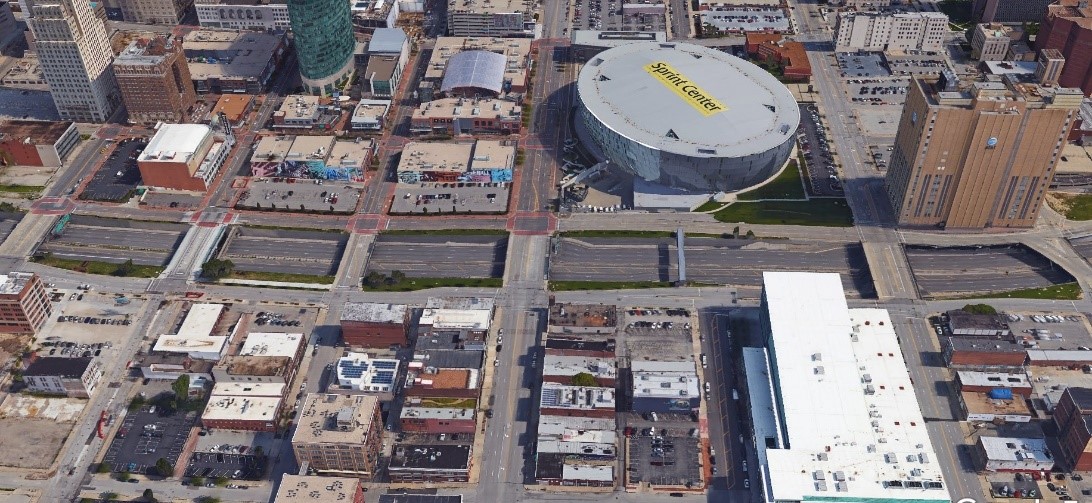
In this picture you can see the road infrastructure in central Kansas City. At the center of the picture is a sunken highway and the level above you can see the wide roads.
Decentralization of powers
"Decentralization has, not only an administrative value, but also a civic dimension, since it increases the opportunities for citizens to take interest in public affairs; it makes them get accustomed to using freedom. And from the accumulation of these local, active, persnickety freedoms, is born the most efficient counterweight against the claims of the central government".
–Alexis de Tocqueville, "Democracy in America"
The US has three levels of transport authorities – municipal, state, and federal. In Israel, the Transportation Ministry centralizes all the roles of each of these transportation authorities.
Israel is significantly smaller than the United States and therefore two levels of transportation agencies are sufficient. Responsibility for transportation infrastructure in the domain of local authorities should be transferred to "metropolitan transportation authorities" in each regional council, local council or municipality, as decided by the government in 2011, a decision which until now has still not been put into effect.
The Transportation Ministry will no longer be the financer and overall director of public transportation companies. Public transportation companies will continue to operate only profitable lines. Considerations for purchasing vehicles, opening and closing lines, the frequency and locations of the stations will be the sole responsibility of the companies.
Upgrading roads
Some argue that the problem of traffic jams on the roads of Israel is endless[9] and that the only solution lies in upgrading train infrastructure, but an examination of "the map of traffic jams" proves that we are talking about a limited and finite list of roads[10]. The answer to the problem of traffic jams will be provided by expanding roads where possible, as was done on the Ayalon Freeway between the JNF Interchange and Galilot, and will significantly improve the traffic flow in this segment.
And in places where it is not possible to expand the road, a second story can be built for roads, as was done in Kobe, Japan, in the city of Chicago in the United States, and in many other places around the world. Even the Iranians built a second story of lanes on the Trans-Tehran highway.
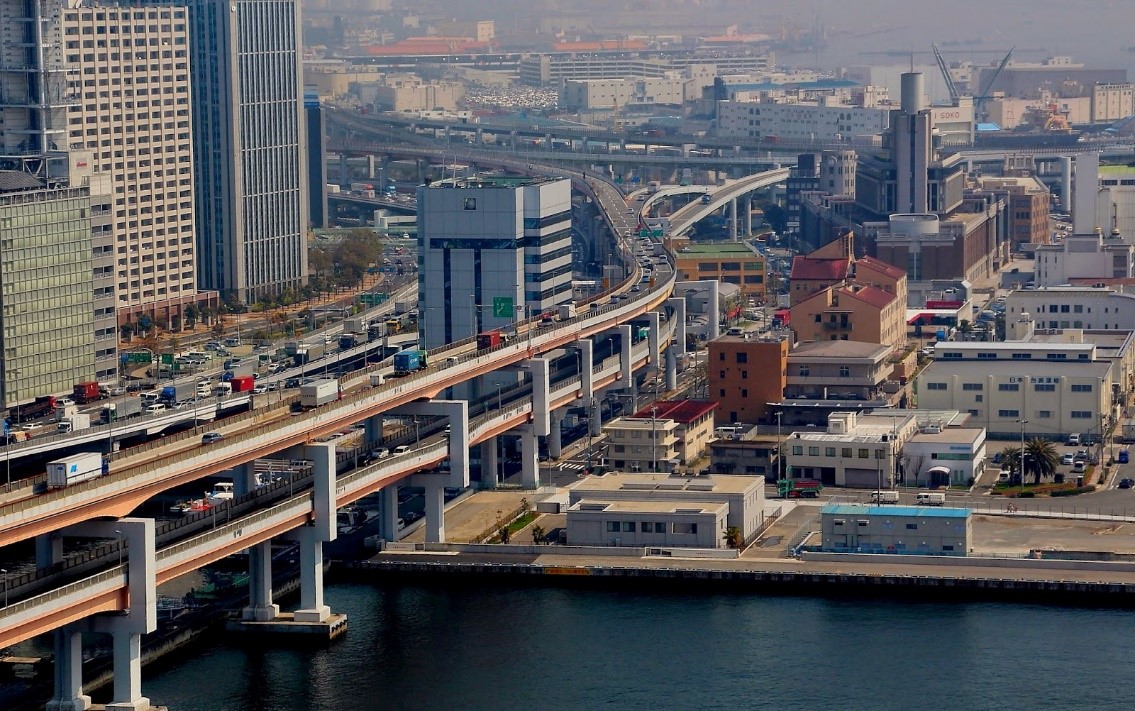
In this picture you can see a two-story highway in Kobe, Japan.
[4] Mishnah Sanhedrin, Chapter 2, mishnah 4.
[5] Countries have established transport infrastructure since early antiquity.
[6] For example, the following words on behalf of Transportation Minister Israel Katz from 15.12.2016: "Katz noted that within the framework of Ashdod winning the "Model City for Sustainable Transportation" project, more than a quarter billion shekels will be invested in it for the development of green transportation and encouraging the transition from private vehicles to public vehicles".
[7] Such as Uber and other companies in this field.
[8] 6.3 miles per thousand residents, as opposed to 2.0 in Los Angeles.
[9] Director General of the Transportation Ministry: "We will never catch up the growth rate of vehicles – the public should demand public transportation" – http://www.calcalist.co.il/local/articles/0,7340,L-3697938,00.html.
[10] Highway 1 – from Mevaseret Tziyon to Jerusalem, Highway 2 – from Netanya to Galilot, Highway 4 – from Raanana to Rishon LeTziyon, Highway 4 – from the Eshkolot interchange to Ashdod, Highway 5 – from the Kesem interchange to Galilot, Highway 20 – from the JNF interchange to to Holon, Highway 22 – from Haifa to Kiryat Bialik, Highway 38 – from Mesilat Tziyon to Beit Shemesh, Highway 40 – from the Ramlod interchange to Kfar Saba, Highway 45 – from the Givat Ze'ev interchange to Jerusalem, Highway 57 – from Kfar Yona to Netanya, Route 60 – from Afula to the Achsel interchange, Highway 60 (tunnels) – from Jerusalem to Neve Daniel, Highway 65 – from the Iron interchange to Umm al-Fahm, Highway 66 – from Megiddo to Mishmar HaEmek, Highway 70 – from Yokneam to the Yagur interchange, Highway 85 – from Carmiel to Acre, Highway 444 – from Rosh HaAyin to Shoham.
| << Prev || עברית || Français || Русский || Next >> |