


| << Prev || עברית || Français || Русский || Next >> |
Part Five - The Economic Plan
Transportation (2/2)
Private vehicles and pollution
A claim that arises frequently in discussions about public transportation compared to private vehicles, is that private vehicles pollute much more than public transportation. This argument is incorrect. New cars emit virtually no pollutants into the air. In the US, despite the relatively high level of motorization in the world – about 0.8 vehicles per person, air pollution is much lower than in Israel, where the rate of motorization is 0.365 vehicles per person[11].
Air pollution is caused by a mechanical defect[12] or gasoline with oil additives. The Palestinian Authority, Jordan and Egypt have no annual air pollution testing and loose monitoring of fuel additives. Therefore, in Amman and Cairo, figures are soaring to dangerous values from a health standpoint.
In Israel, the city of Sderot near Gaza and the city of Eilat near Aqaba suffer from high air pollution. By comparison, the city of Haifa, which suffers from a negative image of pollution, is less contaminated than Sderot and Eilat. The distance from Petah Tikva to Qalqilya is about 10 km and as a result, Petah Tikva is more polluted than Tel Aviv.
Since the growing number of private vehicles is not the cause of air pollution, but rather only faulty vehicles and gasoline with oil additives that are accepted only in shoddy countries, Zehut does not see any need to reduce the number of private vehicles in order to improve the environment. Instead, air pollution will be reduced through strict enforcement of fuel quality and licensing institutions.
Reducing taxation and bureaucracy for private vehicle owners
The tax on vehicles today is the customs duty of 83% plus VAT which also applies to the customs component; i.e., 114% in addition to a high annual fee.
The fuel tax is comprised of a "Blo" 3.05 shekels per liter plus VAT which also applies to the "Blo" component"; i.e., about 252% tax.
This high taxation, which funds the public transportation budget, must be lowered, and in particular, the IBA fee of 153 shekels per year, which has nothing whatsoever to do with the subject of transportation, must be eliminated[13].
In many states in the US, there is no annual vehicle test, and in other states, the test is only for air pollution levels. The reasoning behind this policy is that the state does not interfere with private property of citizens. We think it is important to test for safety and therefore Zehut will act to target it by eliminating the clauses that are not related to safety[14].
Competitiveness and innovation in transport
The positive trends of opening up competition in the areas of ports, the seas, and aviation should also extend to ground transportation. Any company can provide public transportation services at its own expense as a regular business when state interference focuses on vehicle safety approval only as will be done for all vehicles in Israel.
In a free country, the state does not determine for the citizen what he may do with his property, and in particular, what he may do with his vehicle. Uber and other car sharing companies will be able to operate in Israel. At the same time, the high tax on taxi cabs will be reduced in order to allow for fair competition.
According to a report by the US Department of Transportation in 2015, 94% of accidents are the driver's fault, 2% are caused by the vehicle, 2% are caused by the environment, and 2% are due to other reasons . As part of the war against traffic accidents, Zehut will act to permit autonomous driverless vehicles in Israel as they were permitted in Michigan in November 2016. In addition, we will act to increase the budget for dealing with dangerous clusters ("Red Roads") in order to make the infrastructure more forgiving of driver errors.
Aviation
In the US, unlike in Israel, there are airports in joint military-civilian use. Sixty nine shared airports under civil aviation supervision ("Shared Use") and 24 shared airports under military air control ("Joint Use") Although the population density in the US is only 32.68 people/km2, and there is plenty of space. By comparison to the United States, Israel's population density is greater by nearly a factor of 12 – 387.55 people/km2 and the shortage of space in Israel today is high.
At the international airport of the city of Tucson in Arizona, which is used has both military and civilian usage, there is a wing of 72 F-16 planes, and they are likely to absorb several dozen F-35s there as well in the coming years. The military part of the airport in Tucson also serves as an international training center for F-16 planes. The types of military airplanes in Tucson are very similar to Israel's aircraft at the airport in Nevatim, but Nevatim is a military airport only, and Tucson Airport is a joint civilian and military airport.
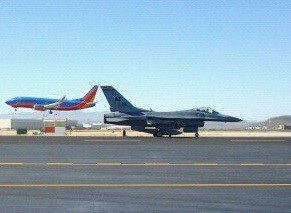
In this picture you can see a civilian airplane taking off from Tucson, Arizona while another runway has an F-16 airplane.
Seven km from Tucson International Airport, the Davis-Monthan airbase is located, which has a wing of 82 A-10 fighter aircraft, so that the skies of Tuscon are far more crowded than those of Nevatim, and even so, civil aviation also manages to find its place in Tucson.
In Tucson, the annual rainfall is 290 mm, and 85% of the year are sunny days. In Beersheba, the annual rainfall is 204 mm, and 92% of the year are sunny days. Beersheba even more of a desert than Tucson.
As the State of Arizona is "the airport capital" of the United States because it is mostly desert state (approximately 8.5% of the citizens of Arizona work in the airline industry, compared with 0.3% in Israel), so should the Negev become the airport capital of Israel. The airport in Nevatim will become a joint civilian-military airport, similar to the existing model of the international airport in the city of Tucson, Arizona, and thus become complementary to Ben Gurion airport. The airport in Nevatim will also provide a solution for the problem of aircraft noise for the many people who live very close to Ben Gurion Airport.
[11] The level of air pollution for 10PM particles and 2.5PM particles according to the World Health Organization: New York 10PM=16, 2.5PM=9, Los Angeles 10PM=20, 2.5PM=11, Chicago 10PM=22, 2.5PM=12, Kansas City 10PM=16, 2.5PM=9, Sderot 10PM=51, PM2.5=22, Eilat 10PM=53, 2.5PM=23, Haifa 10PM=35, PM2.5=18, Petah Tikvah 10PM=57, 2.5PM=24, Tel Aviv 10PM=48, 2.5PM=20, Amman 10PM=68, 2.5PM=36, Cairo 10PM=179, 2.5PM=76. The American standard states that the value should not exceed 50 for 10PM and Europeans even insist on a maximum value of 40. In Israel, so as not to create a crisis with the Arabs, the value was raised to 75. A maximum value of 25 is acceptable all over the world, except the Arab world, as the maximum value for 2.5PM.
[12] Faulty catalytic converters, oil plugs etc.
[13] The TV fee was eliminated with the closing of the Broadcasting Authority Act, but the radio fee collected as part of the annual license fee was not canceled by that law.
[14] Such as the obligation to complete the test within 30 days or the obligation to keep a trash basket in the car.
[15] https://crashstats.nhtsa.dot.gov/Api/Public/ViewPublication/812115
| << Prev || עברית || Français || Русский || Next >> |