


| << Prev || עברית || Français || Русский || Next >> |
Appendices
Israel's security since the Oslo Accords (2/5)
The first Netanyahu government
18 June 1996 ‐ 6 July 1999
Netanyahu continues Oslo
It was clear that Benjamin Netanyahu was not bringing an alternative message with him, but what was not expected was that Netanyahu's lack of message would lead him, shortly after his election, to continue the agreement initiated by his rival and even embrace the PLO leader Yasser Arafat. The damage done by Netanyahu when he subjugated the entire "national camp" to the Oslo process was no less than that of Peres. So long as the process was only the fruit of the left, there was a cloud of illegitimacy above the agreements among the Jewish majority in Israel. Although Israel entered the trap, the road was still open. Netanyahu, who was elected by a tiny majority on the waves of opposition to Oslo, locked the trap on all of Israeli society – which remains trapped in the the process until today.
At the beginning of his tenure, Netanyahu tried to condition the continued implementation of the Oslo Accords and the handing over of Hebron to Arafat upholding his part in the agreement – among other things, to change the articles of the Palestinian Covenant calling for the destruction of Israel – but to no avail[19]. Netanyahu would soon discover that from the moment he recognized their legitimacy and "the just cause of Palestine," he himself became the ultimate robber, the bad guy in the story, who is constantly under the obligation fix things, while the world no longer pays attention to small things such as this paragraph or that "in the vaad bayit agreement of the stolen building."
"If they give, they'll get. If they don't give, they won't get."
On 4 September 1996, Netanyahu met for the first time with Yasser Arafat, while deluding himself that he could shift responsibility for the continuation of the process to the "Palestinian" side. Netanyahu then coined the expression "If they give, they'll get; if they don't give, they won't get," and insisted on the "Palestinians" fulfilling their commitments in the agreement. Of course the meeting ended with nothing. The principle of "If they give, they'll get; if they don't give, they won't get" was quickly proven to be detached from the new reality of the Oslo process. Arafat quickly realized that Netanyahu had become subjugated to the process, just like his predecessors from the left, and therefore the only valid principle for him was "If they don't give territory – they won't get quiet." Two weeks after the fruitless meeting with Arafat, Netanyahu tried to portray business as usual, but Netanyahu apparently still did not understand the reality that he had nurtured in his meeting with Arafat. In Oslo a monster was been created that can not be destroyed without giving up the agreements and the outlook that gave rise to them. Since Oslo, we have to feed the monster all the time with astronomical sums of money, Israeli sovereignity, and Israeli casualties – in order to buy security and political "artificial quiet" for a while.
The monster can not be eliminated because "this is their country" – they are the just side, and the world expects Israel, which recognized it, to adopt an active process of "repentance," meaning more and more withdrawals, and certainly not the elimination of those whose legitimacy has been recognized. On the other hand, it is impossible to withdraw and provide the monster with its full desire, because, as Ernest Bevin testified in his 1947 speech[20]: "The basic aspiration of the Arabs of Eretz Israel is not national sovereignty in the Land of Israel, but rather the negation of any chance for Jewish sovereignty there." The last thing they want is an independent state, and so both Shimon Peres, Ehud Barak, Ariel Sharon and Ehud Olmert – who tried very hard to give roughly everything – received the same violent response as Netanyahu.
The Western Wall Tunnels
When Arafat realized that Netanyahu had locked himself in the trap of Oslo, he took advantage of his first opportunity – the opening of the Western Wall tunnel for tourists. This was territory under full Israeli sovereignty – an area that in the twenty years since then has always remained open, without any problem. Arafat took advantage of the opening of the tunnel as an excuse to launch an attack that killed 16 Israeli soldiers, some of whom were shot by Israeli weapons that were given to "their friends" the "Palestinians" on the joint patrols that were the pride of the Oslo Accords.
The Hebron Agreement
Netanyahu quickly learned the new principle and handed Hebron, the city of the Patriarchs, over to the "monster", with the exception of a minuscule area near the Tomb of the Patriarchs and the Jewish community, in order to buy a period of quiet, without presenting any demands to the Palestinian Authority, while declaring that it was the implementation of previous agreements. (Despite the fact that the delay in implementing these agreements until the Palestinian Authority met the conditions required of it was at the heart of his declared political position).
Wye agreement and continued withdrawals
The lull lasted only a short time, and in the summer of 1997, the suicide bombings were renewed, which led to pressure, to concessions and to the Wye agreement – according to which Israel was to withdraw from another 13% of the area. To Netanyahu's credit, it should be said that he did not despair, and tried constantly to continue to create some kind of conditioning between the continued withdrawals and the fulfillment of Arab commitments. At the same time, Netanyahu held unofficial talks with the Syrians, and according to the Americans agreed to a complete withdrawal from the Golan Heights, but these contacts did not ripen into an agreement.
In any case, the Netanyahu government was disintegrating due to internal conflicts and disappointment on the right from its policy. The mobilization that Netanyahu enjoyed in the elections against Peres did not repeat itself, and in the 1999 elections, Ehud Barak won.
The Barak government
May 1999 ‐ February 2001
Ehud Barak's short tenure – shorter than any other Israeli government – was characterized by an obsessive desire to reach any political achievement.
Negotiations on the Golan Heights
Barak first turned to the Syrian channel and offered a complete withdrawal to the international border. Barak did not understand that Ernst Bevin's definition of the Jewish-Arab conflict was also valid for the Syrians – the conflict with Israel is an essential part of their self-definition and they must preserve it. The Syrians insisted on an Israeli withdrawal not only to the international border that passes only ten meters east of the Sea of Galilee, but to the actual water line, and a Syrian "partnership" on Israel's main water source. Barak was forced to give up.
Flight from Lebanon
In July 2000, Barak tried to create an "achievement"[21] and ordered a unilateral withdrawal of all IDF forces from southern Lebanon, even without an agreement with the Syrians[22]. The panicked retreat included harsh scenes of Hezbollah's takeover of Israeli equipment, attacks on the retreating IDF forces, and worst of all, the abuse of SLA soldiers and their families who had forged a long-standing blood pact with Israel and in one moment were betrayed and abandoned to their fate[23].
In the wake of the withdrawal, which was presented as a brilliant and tremendous success, all of Lebanon's south is now channeled into more than 150,000 rockets and rockets covering most of Israel, some of them GPS-based, located inside residential buildings, schools, mosques and clinics, and constitutea strategic arm of the Iranian regime against any attempt at Israeli defense against the Iranian nuclear threat. In the final analysis, the withdrawal from Lebanon led to a strategic collapse in the balance of power and deterrence against the Iranian threat.
The Camp David talks
In the same month (July 2000), Barak met with Arafat at Camp David and offered him 90% of all of Judea and Samaria as well as Palestinian sovereignty in the Muslim and Christian quarters of Jerusalem and on the Temple Mount and sovereignty in parts of Jerusalem in return for ending the conflict. Even American President Bill Clinton stood behind Israel's almost complete withdrawal proposal.
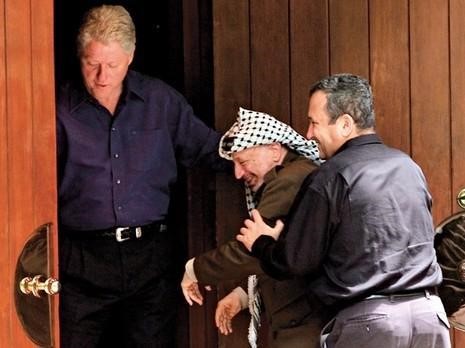
Barak's optimism at the start of the talks was based on his willingness to withdraw from all territory, including the "holy places," and the approach according to which the essence of the conflict is territorial. Of course, Barak failed to do so, and all he achieved was the public announcement: "We have no partner in Arafat at this time."[24]
The Second Intifada
This "achievement" did not help Israel in the international arena. When he was forced to implement the agreement and end the conflict, Arafat, as was his habit, initiated acts of hostility that justified the outbreak of the second intifada. This time, Israeli Arabs, who began, mostly in the north of the country, to participate in violent demonstrations that turned into riots. Twelve Arab citizens of Israel were killed during the riots, and one Jewish citizen, Bechor Jan, was murdered when stones were thrown while he was riding on the coastal road.
Ehud Barak was able to prove again how accurate Bevin's definition was. The basis of the conflict is not the will of the Arabs of the Land of Israel in a state of their own, but their desire to destroy our state. Therefore, any real "progress" in the political process forces them to a violent explosion that perpetuates the conflict, which is at the heart of the "Palestinian" self-definition, and therefore they must continue to achieve their goal – full Jewish withdrawal from all of the Land of Israel.
The sight of the lynching of IDF soldiers in Ramallah (12 October 2000) shocked the Israeli public: The Arab casualties increased the internal and international pressure, the Barak coalition disintegrated, the Arab factions withdrew their support, and Barak was forced to announce his resignation and run for new elections.
[19] In practice, the Palestinian Covenant has never been changed, despite the PLO's misrepresentations.
[20] British Foreign Minister during the end of the Mandate in the Attlee government. One of the supporters and architects of the White Paper policy and the British preference for the Arabs, and not a lover of Zion, to say the least.
[21] In Israel, every withdrawal makes the responsible leader the media favorite and the "etrog", immune to criticism and sometimes even immune from investigation. This fact may, and in fact did, also have had an effect on Barak's reckless and irresponsible withdrawal in view of the investigations against him at the time about the associations.
[22] At the same time, the Syrian army and intelligence forces were stationed in Lebanese territory and dictated to a large extent what was happening there.
[23] The South Lebanon Army (SLA) operated in southern Lebanon from the end of the 1970s until the IDF withdrew from Lebanon in May 2000. The SLA acted as an extension of the IDF to assist Israel's defense in southern Lebanon, primarily by protecting the "Security Belt"near the Israeli border. In order to understand the extent of the partnership, it should be noted that the Israeli Defense Ministry was responsible for the SLA budget. The withdrawal from Lebanon fell on the SLA fighters like a thunderstorm on a clear day, placing them and their families at immediate risk. On the day of the IDF's withdrawal from Lebanon, approximately 7,800 SLA members and their families fled to Israel. Over the years since the withdrawal, no less than 3,000 of them have given up and returned to Lebanon, despite the danger to their lives. Some of the returnees are still imprisoned to this day; The lives of others have become hell. Among the harassment they undergo, former SLA members are called to Hezbollah investigations to determine whether they still hold allegiance to Israel – the state that did not know how remain loyal to them.
SLA soldiers fought, injured, and were killed alongside IDF soldiers. This was Israel's most significant alliance with any faction in the Arab world. A historic alliance no less important than the peace agreements with Egypt and Jordan, due to the fact that a party outside of Israel's borders decided to actively stand by us. Not secretly, but openly – on the battlefield, shoulder to shoulder with IDF soldiers.
Over the years the IDF operated in Lebanon, nearly 600 SLA fighters were killed and close to 1,500 injured.
Beyond the moral obligation to the SLA fighters, the treatment of their distress is also a strategic interest of the first order. The Arab world is watching to see how Israel treats its allies, and abandoning them will make it even more difficult to form alliances with communities and countries in the region. The plight of the SLA fighters is widely known in the Arab world, and serves Hezbollah as a propaganda tool: The message to those who considered cooperating with us is clear: At the moment of truth, Israel abandons its friends and allies.
(Some of the things here have been copied from the words of Eli Avidar, chairman of the Forum for the Middle East, a former head of the Israeli delegation in Qatar).
[24] The importance of this public announcement should not be underestimated, because for the first time since the beginning of the "peace process with the Palestinians", the most senior and authorized official in Israel publicly admitted that peace can not be achieved. This announcement, and the difficult events shortly after, allowed a large Israeli public to finally recover from the illusion that the Oslo process would achieve peace.
| << Prev || עברית || Français || Русский || Next >> |